
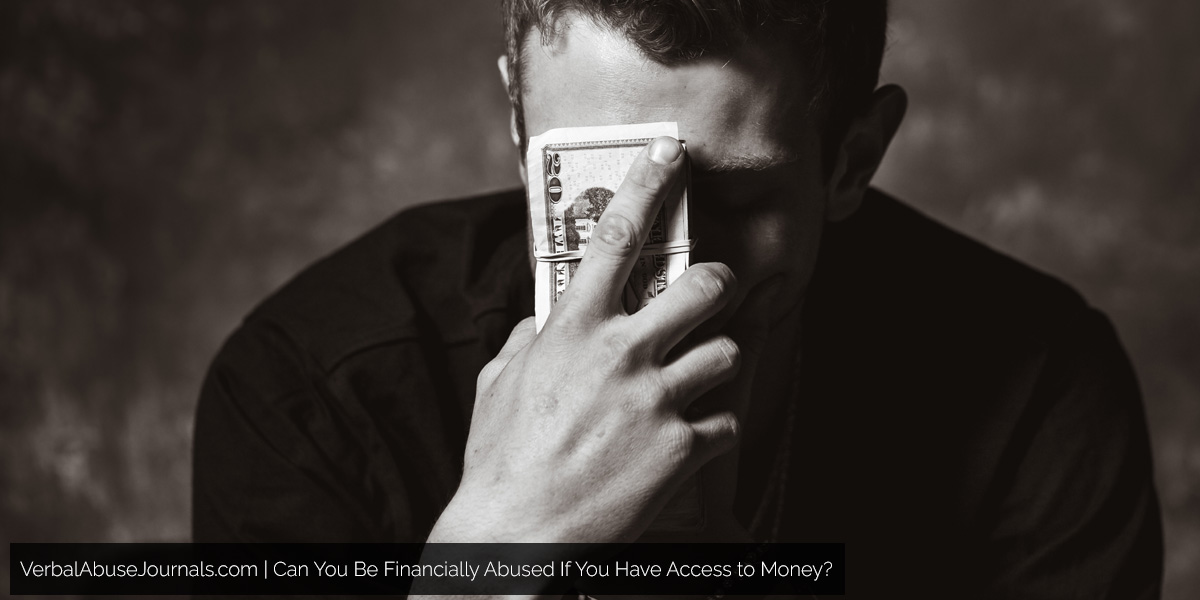
Yes. You can be financially abused even when you have access to money. You can have your own checking account, a retirement account, a paycheck, and full control of the budget, and still be financially abused.
Access is not the same as safety. What matters is whether someone else is using money to control you, punish you, or keep you stuck.
Ways Financial Abuse Happens
A partner may:
- take out credit in your name without permission
- destroy your credit rating
- prohibit you from working or going to school
- refuse to pay any household bills, which forces you to pay them
- keep you in danger of losing your home by overspending or “forgetting” to mail the mortgage payment
- stop paying child support or other court-ordered payments after a divorce
- hide income so it can’t be used to figure child support
- move money from your joint account into a secret account without telling you
- give you financial gifts and expect your compliance in return
- blame you for overspending when you’re the one sticking to the budget
- refuse to keep steady employment
- or any number of things a person can do to undermine another person’s financial life.
The point of financial abuse is to make financial independence hard to reach. If you believe you can’t make it alone, you’re less likely to go. And even when you have money, or know you could survive on your own, long-term verbal abuse makes it very hard to see yourself as capable of living in the real world.
Access Isn’t Control
Financial abuse is easy to miss when the money runs through your hands. Some questions worth sitting with:
- Do you manage the money but get blamed for the results?
- Does your partner agree to a budget and then spend outside it anyway?
- Are you interrogated about ordinary purchases?
- Does your partner refuse to look at the numbers, then act shocked by the numbers?
- Are you discouraged from working, earning more, or going to school?
- Does your partner spend freely on themselves while you go without?
- Have you taken on debt, a loan, or a bankruptcy that belonged to both of you?
- Do you know what your credit report says right now?
If several of those land, the money isn’t really yours to control. You’re holding the responsibility while someone else holds the power.
Financially Abused by Creating Self-Doubt
In some ways, the financial abuse in my marriage was his emotional and verbal abuse about money. He accused me of overspending, hiding money, and wasting his hard-earned money. His words branded themselves into my mind. Five years after leaving him, I still had a hard time believing I could reach financial independence, even though I obviously had.
The financial abuse in my marriage was covert, because I always had access to the money. From the beginning, I budgeted, invested for retirement, paid the bills, and shopped for our family. My husband wanted nothing to do with the money except when he felt a need to berate my stupid decisions or lecture me about how I nickel and dimed us to death. I spent hours with my angry, explosive husband explaining
- why we had more than a mortgage and a utility bill,
- why our credit balance kept climbing,
- our budget,
- and mostly, “Where did all the fuckin’ money go, Kellie?”
No true answer satisfied him. It amazes me that he undermined our family’s financial health to create reasons to abuse me. And what on earth was he thinking? Why wouldn’t we have more than two bills a month? Nonsense. But at the time, I thought explaining it to him would make all the difference.
Undermining
It made me crazy that he distrusted me and still wouldn’t take responsibility for budgeting or his own spending. I’d set a budget. He’d agree to it. Then he’d come home that night with a special tool he had to have or a deal he couldn’t refuse.
I reworked the budget countless times, but the money wasn’t there. I came to rely on credit cards, robbing Peter to pay Paul. Our debt rose slowly and surely. He used the cards too, so when he acted surprised and outraged over the debt, I felt betrayed and frankly baffled.
Financially Abused Because of What Should Be
He worked, but the money wasn’t there the way he thought it should be. At one point he took a second job. Having more money only meant he spent more money. He spent freely on liquor and beer, going out with friends, and fixing up his truck.
Yet he didn’t want me to take a job or go to college or do anything to help our family make ends meet. I was a housewife. Housewives stayed home. His old-fashioned ideas about what it meant to be a man, and a woman, created a fantasy of what should be instead of what was. He didn’t make as much money as he thought he deserved, and that is what made him furious. Not my money-handling skills.
Bankruptcy
When both children were in school, I started a furniture refinishing business in our garage. When he saw that I could make it work, he decided to act on his idea of owning a towing company. The expenses for his towing company, and the garage space I had been using, came before everything else, and I accepted that as fact.
I came to believe that dropping my business in favor of his, because he was, after all, the husband, was the right thing to do. So I transferred our credit card debt to my business credit card. A few months later I declared bankruptcy on my own so he could have the clean slate he wanted. I took the credit hit because
- he badgered me relentlessly to do it,
- he blamed me for the debt, and
- he said my credit rating wasn’t important anyway.
I look back on that and want to berate myself. I don’t, because I know now what abuse does to a person, and I was no exception.
Financially Abused Without Realizing It
One day when money weighed heavy on my mind, an angel gave me some cryptic financial advice. The angel reminded me that no more capable hands could free us from our financial problems. I see it now as a gentle jab letting me know Will couldn’t do any better. I was blind to that hint and the others I got that day.
Yes, I was financially abused during my marriage, and I had complete access to the money the entire time.
What You Can Do About It
You can’t budget your way out of financial abuse. You can protect yourself while you figure out what’s next. Take these steps only when you can do them safely, because some of them may be noticed.
- Look at your credit report. In the US you can get free reports from all three bureaus at AnnualCreditReport.com. Look for accounts, cards, and loans you never opened.
- Think about a credit freeze. Freezes at Equifax, Experian, and TransUnion are free and stop new credit from being opened in your name. Consider first whether your partner would notice and how he would react.
- Copy your documents. Birth certificates, Social Security cards, tax returns, pay stubs, bank and retirement statements, titles, deeds, and insurance policies. Keep the copies outside your home, with someone you trust or at work.
- Keep records of the money. Note dates, amounts, and what was said. Records help later when you talk with an advocate, a lawyer, or a judge, and they help you trust your own memory when you’re told the problem is you.
- Set something aside if you can do it safely. Cash or an account at a different bank with paperless statements going to an email he doesn’t know about.
- Protect your devices. Shared accounts, banking apps, and browser history can show what you’ve been reading and doing. Look into help on a device he can’t get into. No method is completely private.
- Ask an advocate about your options. Domestic violence programs help with financial questions, and some can connect you with free legal help. You don’t have to be leaving to call.
Financial and legal rules vary by state and by country, so check with a local advocate or an attorney before you make a big move, like closing a joint account or filing anything.
If you need to talk it through. US: National Domestic Violence Hotline, 1-800-799-7233, text START to 88788, or chat at thehotline.org. Free, confidential, 24/7. Outside the US, contact your local domestic violence service. If you’re in immediate danger, call 911.
Similar Pages
- Am I Abused? (A Quiz)
- Are Abusers Mentally Ill? If So, What Do I Do About It?
- Are Abusers Typically Men? Let’s Stop Assuming They Are
- Can You Be Financially Abused If You Have Money?
- My Abuser Has PTSD. What Do I Do?
- Was I Abused When He Grabbed My Face?
- What Does Living with Domestic Abuse Feel Like?
- Why Can’t I Just LEAVE?
- Why Do Abusers Abuse Others?
- Why Does Gender Bias Exist When Talking About Domestic Abuse?
- Things Abusers Say and Do
- What Is Verbal Abuse?
- Examples of Verbal Abuse