

Have you ever walked away from an argument with your partner thinking, I know what just happened. So why can’t I explain it anymore?
Maybe you started the conversation knowing exactly what you meant. Twenty minutes later, you were defending something you never said, apologizing for something you didn’t do, or wondering whether your memory was going bad.
Then you replayed the conversation.
And replayed it.
And replayed it some more because somewhere between “Can we talk about what happened last night?” and “You’re impossible to deal with,” the original problem disappeared and somehow you became the problem.
That is the kind of mess crazymaking creates.
And when crazymaking happens inside a larger pattern of coercive control, it can change more than how you feel about your relationship. It can affect how you pay attention, remember events, make decisions, judge danger, and trust your own thinking.
That does not mean every nasty argument damages your brain.
It means living in a relationship where somebody repeatedly interferes with your perception of reality takes a mental toll.
First, What Are We Talking About?
“Emotional abuse” is a common term, but it covers a whole lot of territory.
The CDC uses the term psychological aggression for verbal or nonverbal behavior intended to harm a partner mentally or emotionally or to exert control over them. That includes things like insults and humiliation, but it also includes coercive control: monitoring you, isolating you, restricting your access to people or resources, threatening you, and otherwise making your world smaller.
So let’s get more specific.
Verbal abuse uses words to degrade, threaten, manipulate, accuse, intimidate, or control you.
Crazymaking messes with your confidence in what you know. Your partner contradicts themselves, denies things they said, changes the rules, rewrites events, assigns motives to you, or insists your perfectly reasonable perception is evidence that you’re unstable.
Coercive control is bigger than one argument or one insult. It is a pattern designed to restrict your choices and increase the abuser’s control over your daily life.
And brainwashing is the plain-English word I use on this site for what can happen when those tactics pile up long enough that the abuser’s version of reality starts crowding out your own.
Remember Your First Really Confusing Argument?
Think back.
Maybe your partner accused you of flirting when you were making ordinary conversation.
You explained yourself.
They said you were lying.
So you explained yourself better.
They pointed out something you did with your face.
You explained your face.
They brought up something that happened six months ago.
You explained that too.
Three hours later, you were exhausted and apologizing because apparently your face, the produce guy and Christmas at your mother’s house had exposed a serious character defect.
What happened to the original conversation?
Who the hell knows.
But your brain noticed something important: There is danger in getting this wrong.
So next time, you pay closer attention. You think before you speak. You study your partner’s expression. You reconsider perfectly ordinary behavior.
You look for whatever invisible rule you broke last time so you don’t break it again.
That sounds sensible. Your brain is trying to solve the problem. Unfortunately, the problem has no stable solution because the rules keep changing.
Crazymaking Turns Your Attention Toward the Abuser
In a healthy relationship, disagreement does not require you to abandon your own mind.
You can think,
- He disagrees with me.
- Or, She remembers it differently.
- Or even, Well, that was a spectacularly stupid thing I did.
Then you deal with it.
Crazymaking is different because the argument repeatedly comes back to whether you can trust your own perception.
You remember what was said. Your partner says it never happened.
You know why you made a decision. Your partner tells you your “real” motive.
You are angry because they insulted you. They tell you your anger proves you are unstable.
You finally lose your temper after two hours of being picked apart.
Aha!
Now your anger becomes proof that you are abusive.
After enough rounds of this nonsense, you may stop asking, “What did they just do?”
You start asking, “What is wrong with me?”
That shift matters.
Your attention has moved.
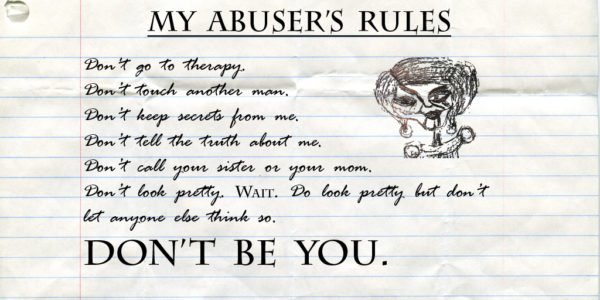
Coercive Control Gives You Fewer Reality Checks
Crazymaking works even better when your partner also controls which voices you hear.
- Maybe they dislike your friends.
- Then your sister is “interfering in our marriage.”
- Your coworker is “putting ideas in your head.”
- Your therapist is “biased.”
- That website you read is “full of bitter women.”
- Your mother “always hated me.”
Funny how every person who questions the abuser eventually becomes unreliable.
Isolation does something very useful for a controlling person: it removes competing versions of reality. If five people who know you well say, “That doesn’t sound like you,” you have information. If nobody is left except the person telling you that you’re selfish, crazy, stupid, dishonest and impossible to love, then guess whose opinion starts taking up all the available space?
That is one reason isolation plays such a large role in coercive control. Your abuser becomes your problem and, at the same time, your main source of information about the problem.
Convenient arrangement.
For them.
Why Thinking Can Become So Damn Difficult
People living with abuse often complain that they cannot think the way they used to.
- They forget things.
- They have trouble concentrating.
- They second-guess simple decisions.
- They rehearse conversations before having them.
- They replay conversations afterward looking for whatever they supposedly did wrong.
- They become indecisive.
- They have trouble finishing things.
- They may feel mentally slow one moment and hyper-alert the next.
That does not automatically mean there is permanent brain damage.
But research on intimate partner violence has found differences in cognitive functions involving memory, attention, processing and executive functioning. Brain-imaging research has also found differences in regions involved with cognition, emotion and memory.
Here is the important part researchers keep pointing out: intimate partner violence is complicated.
Psychological abuse can occur alongside chronic stress, PTSD, depression, anxiety, sleep disruption, physical assault, repeated blows to the head and strangulation. Scientists cannot simply scan somebody’s brain and announce, “Yep. That part right there was caused by three years of gaslighting.”
A 2026 study of women with histories of physical and psychological intimate partner violence illustrates the problem pretty well. The women, as a group, performed lower than expected on some measures of memory, reaction time and executive functioning. But the relationship between psychological abuse severity and individual cognitive abilities was complicated rather than a neat straight line.
So yes, abuse can affect thinking. No, we should not pretend science can tell us that one particular insult shrank your hippocampus on Tuesday.
Your Brain Is Also Busy Trying to Keep You Out of Trouble
There is another piece that does not require a brain scanner to understand.
Imagine trying to write a grocery list while simultaneously wondering:
- Is he mad?
- Did I say something wrong?
- Will she check my phone?
- Should I mention what happened yesterday?
- What if he starts yelling in front of the kids?
- Did I remember to erase that search?
- What mood will she be in when she gets home?
- Will this start another fight?
- Did I actually say what he claims I said?
That is a ridiculous amount of mental work.
Meanwhile, you still have to work, raise children, pay bills, buy groceries, remember appointments and function like a regular human being.
Of course you feel scattered. Part of your attention is always somewhere else.
This Is Where Crazymaking Starts Looking Like Brainwashing
At first, you argue with their version of reality.
Then you investigate it.
Then you accommodate it.
Eventually, you may start using it before they even say anything.
You think:
- He’ll say I’m selfish if I do that.
- She’ll think I’m flirting.
- He’ll say I spent too much money.
- She’ll say I’m being dramatic.
So you change what you do. No argument required. The abuser does not even have to be in the room.
That is one of the nastiest accomplishments of coercive control: eventually, some of the controlling work happens inside your own head.
You begin censoring yourself according to rules somebody else installed.
That is what I mean when I talk about brainwashing in abusive relationships. Not science-fiction mind control.
A gradual takeover of your available reality.
And Then You Start Asking the Abuser If You’re Getting Better
This is the really rotten part.
Crazymaking convinces you that something is wrong with your thinking.
And who do you naturally ask whether you are thinking correctly?
Your partner.
The same person who benefits when you doubt yourself.
Maybe you try to be less “sensitive.”
Less “jealous.”
Less “controlling.”
Less “selfish.”
Less “crazy.”
You monitor your progress by watching their reactions.
If they are happy, maybe you did well. If they explode, maybe you screwed up again.
Except the finish line moves every time you approach it. You cannot become healthy enough to satisfy a system that requires you to remain wrong.
One Important Exception: Head Injury and Strangulation
Difficulty thinking during or after abuse is not always psychological.
If your partner hit you in the head, slammed your head into something, violently shook you, strangled you, put you in a chokehold, or caused you to lose consciousness, become dizzy, see stars or experience memory gaps, tell a healthcare professional what happened.
Intimate partner violence can cause traumatic brain injury, and strangulation can interfere with oxygen or blood flow to the brain. Those injuries may exist even when there is little or no visible injury.
Memory problems, concentration problems, headaches, dizziness, confusion, changes in vision and other symptoms deserve medical attention.
Do not let anybody—including your abuser—explain a possible physical injury away as you being “emotional.”
How Do You Start Getting Your Own Thinking Back?
You do not have to win another argument with your abuser. Thank God, because that plan has probably wasted enough of your life already.
You need independent reference points.
- Write things down when it is safe to do so.
- Record what happened while the memory is fresh instead of waiting until somebody spends three hours explaining why it didn’t.
- Reconnect with people you trust.
- Learn the names of abusive tactics.
- Compare what you are experiencing with information that does not come from the person controlling you.
- Give yourself time to make decisions without demanding that you instantly know the “right” answer.
The point is not to prove that every memory you have is flawless. Nobody’s memory is flawless.
The point is to stop treating your abuser as the final authority on yours.
- Crazymaking trained you to question your reality.
- Coercive control narrowed the number of places you could check it.
- Brainwashing made their voice louder than your own.
Those are connected problems.
And once you understand how the pieces fit together, you can begin pulling them apart.
See also: Undoing Brainwashing: Rebuilding Your Own Reality After Abuse
Photo by Callum Skelton