
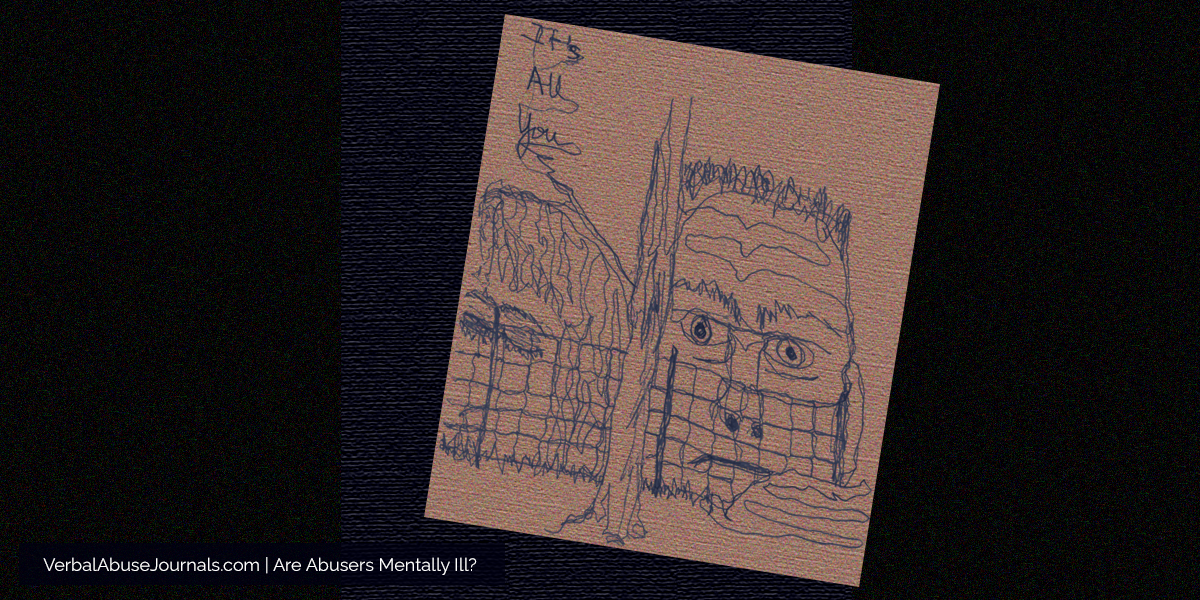
No, Mental Illness Is Not What Makes Someone Abusive.
Are abusers mentally ill? Short answer: no. Mental illness is not what makes someone abusive, and most people with a mental illness never harm a partner.1 Some abusers do have a mental health condition or an addiction, and some do not. Neither gives anyone a pass, and treating either does not guarantee the abuse will end.
Only 3%-5% of violent acts can be attributed to individuals living with a serious mental illness. In fact, people with severe mental illnesses are over 10 times more likely to be victims of a violent crime than the general population. 2SAMHSA, US Department of Health and Human Services
No one can say your abuser is mentally ill without an official psychiatric diagnosis. Yes, some abusers are mentally ill. Some people became abusive after strokes, during dementia, or while suffering from posttraumatic stress disorder.
Research does link some conditions to a higher likelihood of partner violence across groups of people. The CDC lists depression and suicide attempts, antisocial personality traits and conduct problems, and traits associated with borderline personality disorder among the individual risk factors for using partner violence.3
A 2014 review by Oram and colleagues pooled 17 studies with 72,585 participants. People with depression, generalized anxiety disorder, and panic disorder were more likely to report ever having been physically violent toward a partner, with odds about two to three times those of people without these conditions.4
A 2019 Swedish register study by Yu and colleagues followed men with and without psychiatric diagnoses. Those with depression, anxiety, alcohol or drug use disorders, or personality disorders were more likely than men without a diagnosis to be arrested for partner violence, and most men in every one of those groups had no such arrest.5
What About Alcohol and Drugs?
Lisa Aronson Fontes, PhD, writes that alcohol and drugs do not cause abuse, although they can make it worse and more frequent.1 She also notes that people who abuse often behave well in public and choose their timing and targets, and she describes addiction as one of the excuses they use to shift blame.1
Does Treating a Mental Illness or an Addiction Stop the Abuse?
Not reliably. Fontes reports that treatment for mental illness does not necessarily reduce violence, and that people who finish substance abuse treatment may become less violent and still stay controlling.1 She quotes Christine Cocchiola, DSW, who says the abuse rarely stops even when the person completes treatment. You cannot fix someone who abuses, and you are not responsible for their recovery.
Knowing Mental Illness Doesn’t Excuse Our Abusers
It may feel comforting to imagine your abuser is mentally ill. It is easier to believe that your abuser is not at fault if he or she has an illness. However, remember that you define abuse. You decide if your loved one’s behavior is abusive or not. The abuser doesn’t get to tell you if they abuse you or not. And no matter the reason behind your partner’s abuse, you get to decide when enough is enough. You get to choose to protect yourself (or not) from mental, emotional, and physical violence.
That said, it was bone-chilling to realize that my ex-husband abused me with control. He knew what he was doing. And even if he lived with an undiagnosed mental illness, I can rely on this truth:
Abuse and mental illness are two separate issues. If in fact your partner does have a mental health concern, this is a separate issue to the abuse and he needs to work on and address both concerns. If he also abuses drugs or alcohol, this is a third issue that he needs to work on. None of these can be used as an excuse to abuse. ~From WhenLoveHurts.com
No matter how disassociated from reality my ex-husband seemed, he was not mentally ill. He was a perfectly sane, controlling, abusive man. People who abuse often choose their behavior, whatever else is going on with them.
He acted crazy but I felt crazy. My ex-husband wasn’t mentally ill, but his behavior caused me to doubt my sanity.
What Do I Do If My Abuser Is Mentally Ill?
It is very important to set strong personal boundaries if your abuser is mentally ill or not. If you find out that your abuser lives with a mental illness, setting boundaries is of utmost importance. Here’s one that I particularly like, written by a person living with bipolar disorder:
Mental illness is no excuse for being abusive and will not be tolerated. If you persist on being verbally abusive, I will remove myself from the situation. If you continue, I will remove you from my life and get a restraining order if I have to. When I feel like I’m in danger, you hurt me, or you threat to kill yourself or me, I will notify authorities.
~BipolarManifesto.com
A boundary can be a private decision about what you will do. Telling a person who abuses you where your limits are, or what you will do if they cross them, can make them angrier or more dangerous. If you live with the person, or you are worried about how they will react, think about your safety first. See Safety Planning for Domestic Abuse and Violence.
You might want to research the mental condition so you know what symptoms you can expect. If the person might see your search history, research on a device and account they cannot reach. Antidepressants usually take 4 to 8 weeks to work, and some other psychiatric medications also take several weeks to reach full effect.6 Look into all of this yourself. Your partner might not tell you the truth. The stigma of having a mental illness makes people think you’re weak. We all know that an abuser can’t have “weakness” hanging over their heads (unless they’re using it to manipulate you). Anyway, the more you know about your partner’s mental illness and medication, the better off you will be.
There’s a saying that living with disease causes dis-ease. Well, living with abuse, whatever is behind it, is linked to anxiety disorders, depression, and posttraumatic stress disorder (PTSD).7 You should look into the symptoms of those illnesses and talk to your doctor about how you’re feeling. A doctor or counselor can talk with you about treatment options, which may include therapy or medication.
In the end, there is no excuse for abusing another person, ever. It is up to you to decide when or if to leave your abusive relationship no matter what is going on with your partner. And, if I may add my opinion knowing what I know now, I’d leave today. You can help them from a distance if you feel it is necessary. If you decide to leave, plan it first, because leaving can be a dangerous time and extend for around two years. See Safety Planning for Domestic Abuse and Violence.
Suggested Reading
Should I Stay or Should I Go? by Lundy Bancroft defines the difference between domestic abuse and mental illness.
The Gift of Fear: Survival Signals That Protect Us From Violence by Gavin de Becker reminds us of some danger signals we become numb to in abusive relationships.
Sources
Sources checked October 8, 2026. A note under a source says what it covers and what it leaves out.
1 Fontes, Lisa Aronson, 2024. Abuse Cannot Be Blamed on Alcoholism or Mental Illness. DomesticShelters.org. Dated February 21, 2024; the page says it was first published in 2017.
Note: A general-audience article, not a study. It cites research without giving figures, and its statements about treatment outcomes come mostly from the author and one practitioner she quotes.
2 SAMHSA. Get the Facts about Mental Health. US Department of Health and Human Services. Last updated April 24, 2023. The same text was formerly on mentalhealth.gov.
Note: The figures describe violence in general, not partner abuse, and the page gives no source for them.
3 Centers for Disease Control and Prevention. Risk Factors for Intimate Partner Violence. Last reviewed February 8, 2024.
Note: The CDC states that these risk factors may or may not be direct causes. They describe groups of people and cannot tell you whether any one person will use abuse.
4 Oram, Trevillion, Khalifeh, Feder, and Howard, 2014. Systematic review and meta-analysis of psychiatric disorder and the perpetration of partner violence. Epidemiology and Psychiatric Sciences, 23(4), 361-376.
Note: The review looked at lifetime physical violence toward a partner, not verbal abuse, and it could not produce estimates for violence in the past year. The odds describe groups and do not show that a diagnosis causes abuse.
5 Yu, Nevado-Holgado, Molero, D’Onofrio, Larsson, Howard, and Fazel, 2019. Mental disorders and intimate partner violence perpetrated by men towards women: A Swedish population-based longitudinal study. PLoS Medicine, 16(12), e1002995.
Note: The study followed diagnosed men in Swedish national registers and counted only partner violence that led to an arrest, so it captures mainly more severe cases. It is observational and cannot show that a condition causes abuse.
6 National Institute of Mental Health. Mental Health Medications. Last reviewed December 2023.
Note: Timing varies by medication and by person. A prescriber can tell you what to expect from a specific medication.
7 Dokkedahl and colleagues, 2022. The psychological subtype of intimate partner violence and its effect on mental health: a systematic review with meta-analyses. Systematic Reviews, 11, 163.
Note: The authors rated most of the included studies as low quality. Most were cross-sectional, and most included only women. The review shows that PTSD, depression, and anxiety occur together with psychological violence. It cannot show that one causes the other.